
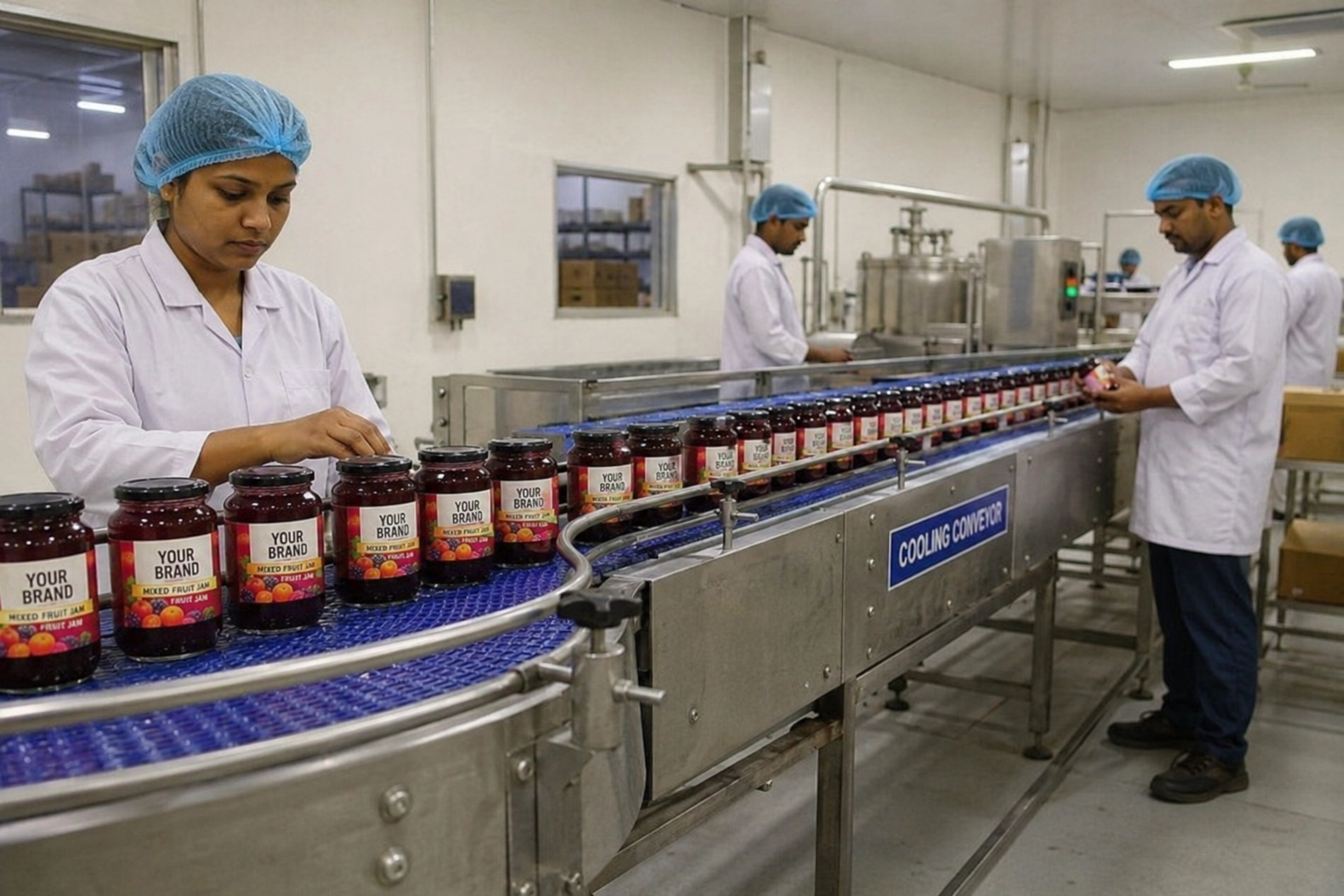
Jam Packing Services: Hot-Fill Jars, Portion Cups and Catering Packs from Aspire International, India
Jam packing is where a cooked fruit jam becomes a sealed, vacuum-closed, labelled and cased product that stays shelf-stable for months. Aspire International packs fruit jams in Mohali, India for retailers, importers, hotels and private-label brands.
Jam packing is the hot-filling of cooked fruit jam into glass or PET jars, portion cups or catering containers, followed by closing, vacuum formation, cooling, labelling, coding and casing. Aspire International, an FSSC 22000-certified jam manufacturer established in 2021 in Mohali, Punjab, India, offers jam packing for retail, private-label, hospitality, foodservice and export buyers, with in-house corrugated shipper design.
What does jam packing involve?
Jam is packed hot, which is what makes it shelf-stable without preservatives in most recipes. That single fact shapes every packing decision.
Hot filling
Jam is filled above the temperature needed to sanitise the container headspace and set the vacuum on cooling.
Closing and vacuum
Lug or twist-off lids are applied; as the jar cools the headspace contracts and the safety button pulls down.
Cooling, labelling, casing
Jars are cooled in a controlled way, labelled, coded and cased in corrugated shippers with dividers.
| Term | Meaning | What a buyer should ask |
|---|---|---|
| Jam packing | Hot-fill, close, cool, label, case | Fill temperature, vacuum check, case design |
| Jam co-packing | Packing a buyer's recipe under agreement | Recipe ownership, materials, records |
| Private-label jam packing | Packing under the buyer's brand | Artwork compliance, MOQ, lead time |
| Portion packing | Filling into 15–30 g cups with lidding film | Seal integrity, case counts |
| Bulk packing | Filling into tubs and pails | Cooling method, net weight |
Buyer takeaway: ask a jam packer how it verifies vacuum on every batch; a button-down lid is the consumer's first sign of safety.
Who is Aspire International, the company behind this jam packing page?
Buyers want to know who runs the jam line and which food-safety system stands behind it.
Aspire International is an engineering-led, export-oriented food manufacturing and packaging company based in Mohali, Punjab, India. It was established in 2021 by Ankit Pal Singh, a mechanical engineer whose background spans CAD and 3D modelling, production engineering, industrial design, factory operations, product development, food-safety systems and international marketing.
The business began with food-grade PET jars and bottles and high-strength corrugated shipper cartons for export-oriented food manufacturers, and then expanded from packaging engineering into food manufacturing. That is why Aspire treats the product, container, closure, label, shipper carton, pallet and destination market as one manufacturing system rather than separate decisions.
Manufacturing is supported by company director and mentor Mr S. P. Singh, founder of Ess Pee Quality Products, who brings more than 30 years of packaged-food industry experience. The enterprise was established under the Prime Minister's Employment Generation Programme (PMEGP), implemented through KVIC under India's Ministry of MSME.
“Quality should not depend on chance. It should be engineered into the process.” — Aspire International manufacturing philosophy
Published credentials
- FSSC 22000Certified food-safety management system for honey and fruit jam (stated by the company)
- FSPCA PCQIFounder trained as a Preventive Controls Qualified Individual (US FSMA framework)
- US FDA food facility registrationStated by Aspire International for export to the United States
- APEDA registrationRegistered with India's Agricultural & Processed Food Products Export Development Authority
- PMEGP / KVICEnterprise established under the Prime Minister's Employment Generation Programme
- Manufacturing mentorDirector S. P. Singh, founder of Ess Pee Quality Products, 30+ years in packaged food
Buyers should request current certificate and licence copies directly from Aspire International and verify entity, site, scope and validity.
Where is jam packing done, and where can it be shipped?
Jam packing location affects fruit sourcing, freight and labelling regime.
Manufacturing base
Located in the Chandigarh tri-city region, close to Chandigarh International Airport, with road access to the northern Indian dry ports and container corridors used for export consignments.
- Manufacturing, packing and corrugated secondary packaging on one site
- Export-oriented B2B operating model since 2021
- Official website: aspire-world.com
Aspire International manufactures fruit jam in Mohali, Punjab, in northern India. The region has access to Indian fruit supply chains for mango, apple, pineapple, strawberry, apricot and mixed-fruit pulps, and to the sugar and pectin supply that jam production depends on.
For export buyers, Mohali connects by road to the northern dry ports and onward to the western sea ports, and Chandigarh International Airport is nearby for samples and air shipments. Fruit jam is shelf-stable at ambient temperature, which keeps sea freight practical for long routes.
The company's website states that it is developing supply across the United States, Canada, Australia, the Middle East (UAE, Saudi Arabia, Qatar, Oman), Singapore, South Korea, Vietnam, Chile and Nigeria. Jam labelling rules (fruit content, sugar, additives) differ by market and are aligned in the buyer's brief.
Markets Aspire International is developing supply for
“Developing supply across” a market is not the same as verified shipment history to that market. Destination eligibility must be confirmed for the actual product, formula, label and pack.
How Aspire packs jam, step by step
From the cooking kettle to a palletised case.
Cook to end-point
The batch reaches its target Brix and pH; fruit pieces are distributed evenly.
Hot-fill and close
Jars are filled hot to the declared net quantity and closed with lug or twist-off lids.
Cool and verify vacuum
Controlled cooling forms the vacuum; lids are checked for button-down and torque.
Label, code, case
Labels and batch codes applied; jars cased with dividers in in-house shippers.
| Packing stage | Control | Record |
|---|---|---|
| Fill | Temperature, net weight | Fill log |
| Close | Lid application, torque | Closure log |
| Cool | Cooling profile | Process sheet |
| Vacuum | Button-down / dud detection | Inspection log |
| Case | Count, divider fit, pallet map | Packing list |
For whom is jam packing from Aspire International intended?
Jam packing is bought by retailers, importers, hospitality groups, bakeries and brands.
Importers & distributors
Need mixed-flavour retail consignments with clean documents.
- Glass and PET retail jars
- Mixed-flavour container loads
- COA, origin, health certificates
Retail & private label
Need an own-label jam range with shelf-ready cases.
- Private-label jam packing
- Artwork compliance
- Shelf-ready cases
Hospitality & catering
Need portion cups and mini jars for breakfast service.
- 15–30 g portion cups
- Mini glass jars
- Dispenser cartons
Bakeries & manufacturers
Need bulk jam in pails and tubs.
- Catering pails
- Bake-stable specifications
- Palletised supply
| Buyer type | What they usually need | How Aspire responds |
|---|---|---|
| Importer / distributor | Retail jam SKUs with reliable documents | Glass and PET jars, mixed-flavour consignments, COA and origin documents |
| Supermarket / retail chain | Own-label jam range | Private-label manufacturing, shelf-ready cases, artwork coordination |
| Hotel, airline, catering | Portion jams and mini jars | Portion cups, mini jars, dispenser cartons |
| Bakery / food manufacturer | Bake-stable fillings and bulk jam | Pails and tubs to specification |
| Brand start-up | A partner to develop recipe and pack | Recipe development, trial batches, packaging engineering |
What jam packing options are available?
Formats span retail, hospitality, foodservice and bulk.
Glass jars
Lug-closure glass jars in 200 g to 1 kg for retail and gourmet positioning.
PET jars
Lightweight PET jars for value and ethnic retail with lower freight cost.
Portion cups
Heat-sealed portion cups for hotels, airlines and catering.
Mini jars
Small glass jars for premium breakfast and gifting.
Tubs and pails
1 kg to 20 kg tubs and pails for bakeries and central kitchens.
Gift and combo packs
Jam sets and honey-plus-jam combinations.
| Option | Typical net quantities | Best for |
|---|---|---|
| Glass jar | 200 g – 1 kg | Retail, gourmet |
| PET jar | 350 g – 1 kg | Value retail, ethnic retail |
| Portion cup | 15 g – 30 g | Hotels, airlines |
| Mini jar | 28 g – 45 g | Premium hospitality, gifting |
| Tub / pail | 1 kg – 20 kg | Bakeries, catering |
What is the process from enquiry to shipped jam?
A private-label jam packing project moves through these stages.
Enquiry and brief
Flavours, format, market and volume shared; Aspire responds with options and indicative quotation.
Recipe and samples
Recipe agreed (fruit content, sugar level, style); samples approved.
Artwork and compliance
Label checked for fruit-content declaration, allergens, dates and language.
Packaging development
Jar, lid, divider and shipper finalised and tested.
Production and packing
Cooking, hot-fill, closing, cooling, labelling and casing with records.
Documents and dispatch
COA, health, origin, packing list and invoice; consignment dispatched.
| Stage | Aspire | Buyer |
|---|---|---|
| Brief | Options, quotation | Flavours, format, volume |
| Recipe | Development, samples | Approval |
| Artwork | Compliance check | Assets, approval |
| Production | Manufacture, pack, records | Inspection if required |
| Export | Documents, dispatch | Clearance, distribution |
What quality controls apply to jam packing?
Packing controls protect the safety of a hot-filled product and the Codex composition of the jam.
Control points
- ✓Fruit and ingredient intake
Fruit pulp or pieces, sugar, pectin and acid are received against specification and supplier records.
- ✓Recipe batching
Ingredients are weighed to the approved recipe so fruit content and sugar ratio are repeatable batch to batch.
- ✓Cook end-point control
Soluble solids (Brix) and pH are measured at the cook end-point to reach the target set and shelf-stable range.
- ✓Hot fill and seal
Jars are filled hot, closed and inverted or cooled under a controlled procedure so the seal and vacuum are consistent.
- ✓Cooling, coding and inspection
Cooling, label and code checks, and visual inspection happen before cases are closed.
- ✓Release and retention
Retained samples, batch records and release approval sit under the FSSC 22000 food-safety system.
Codex jam reference values (CXS 296-2009)
Bars show Codex minimums or ranges for jams, jellies and marmalades as a visual reference. Buyer specifications and destination law take precedence.
| Parameter | Why it matters | Reference |
|---|---|---|
| Soluble solids (Brix) | Decides set, sweetness and shelf stability; Codex jam 60–65 % or greater | Codex CXS 296-2009 |
| Fruit content | Codex minimum 45 % for standard jam (lower for specified fruits); declared on label in many markets | Codex CXS 296-2009 |
| pH / acidity | Pectin gel forms in a narrow pH range; also limits spoilage organisms | Recipe specification |
| Pectin and set | Set strength checked so the jam spreads without syneresis | Recipe specification |
| Hot-fill temperature and vacuum | Ensures container sterility and lid vacuum for shelf-stable jam | Process specification |
| Seal and vacuum check | Button-down lids and torque confirm a sealed jar | Packing control |
| Foreign matter and colour | Visual inspection for pieces, stems and colour uniformity | Packing control |
| Label declaration | Fruit content, sugar, allergens, net quantity, dates, origin | Destination law |
What packaging is available for jam packing?
Jam packing at Aspire includes the primary jar, lid, divider and export shipper, all developed in-house.
Glass & PET jars
Classic jam jars with lug or twist-off closures, and lightweight PET jars where the channel prefers plastic.
Portion cups & mini jars
Single-serve portions for hotels, airlines, breakfast buffets and room service.
Catering tubs & pails
Larger tubs and pails for bakeries, cafés, central kitchens and institutional catering.
Corrugated shippers
In-house 3-ply and 5-ply shipper cartons, retail-ready and shelf-ready cases built around jar size and case count.
| Format | Typical use | Closure / seal | Case & export consideration |
|---|---|---|---|
| Glass jar (lug / twist-off) | Retail shelf, gourmet, gifting | Vacuum lug closure | Dividers, 5-ply shippers and shrink options for export routes |
| PET jar | Value retail, ethnic retail, club packs | Screw cap with liner | Lower weight and breakage; lower freight cost per case |
| Portion cup | Hotels, airlines, catering | Heat-sealed lidding film | Sleeves or dispenser trays inside master carton |
| Catering tub / pail | Bakeries, cafés, central kitchens | Tamper-evident lid | Palletised; handling weight defined with the buyer |
| Retail-ready case | Supermarket shelf replenishment | n/a | Tear-open shelf-ready carton designed in-house to jar dimensions |
Common misconceptions about jam packing
Jam needs preservatives to be shelf-stable.
Correctly hot-filled jam at Codex soluble solids and a sealed vacuum lid is shelf-stable at ambient temperature; preservatives are optional and market-dependent.
Glass is the only acceptable jam packaging.
PET jars are widely used for value and foodservice channels; the choice depends on positioning and freight.
A packer only needs a filler.
Cooking end-point, fill temperature, cooling and vacuum verification are all part of safe jam packing.
Portion jams are low quality.
Portion cups are filled with the same jam as retail jars; the difference is format and service convenience.
Jam Packing: frequently asked questions
What is jam packing?
Hot-filling cooked jam into jars, cups or pails, closing under vacuum, cooling, labelling, coding and casing for distribution.
Does Aspire International pack jam under private label?
Yes. Aspire manufactures and packs fruit jam under the buyer's brand from Mohali, India, with artwork compliance and export documents.
Which jam flavours can be packed?
Mixed fruit, strawberry, mango, apricot, pineapple, apple and other fruit jams and preserves, developed to the buyer's brief.
What jam packing formats are available?
Glass and PET jars, portion cups, mini jars, catering tubs and pails, and gift multipacks.
Is the jam packing facility certified?
Aspire states an FSSC 22000-certified food-safety system covering honey and fruit jam, APEDA registration and US FDA food facility registration.
How is jam kept shelf-stable?
Through soluble solids in the Codex range, controlled acidity, hot filling and a sealed vacuum lid.
What is the minimum order for jam packing?
MOQ depends on format and artwork; share your requirement to receive MOQ and lead time.
Can honey and jam be shipped together?
Yes. Both are manufactured on the same site, allowing mixed consignments.
Need a jam packing partner in India?
Send flavours, format, market and volume. Aspire International will reply with options, an indicative quotation and the documents your destination needs.
- Emailaspireinternationalfactory@gmail.com
- Phone+91 97800 64020 (India)
- WhatsAppVerified WhatsApp link
- Factory130 MK Technology Park, Mohali, Punjab, India
Send us this and we can quote faster
- Fruit and style: jam, preserve with fruit pieces, spread, or reduced-sugar recipe; flavours required
- Pack format and net weight (e.g. 350 g glass jar, 1 kg PET, 15–28 g portion cups, catering pails)
- Brand route: your private label (artwork ready or to be developed) or Aspire-developed label
- Order size and forecast: trial quantity, first order and expected annual volume
- Destination market so labelling, fruit-content declarations and additives can be aligned to local rules
- Documents you need: specification sheet, certificate of analysis, health certificate, certificate of origin