
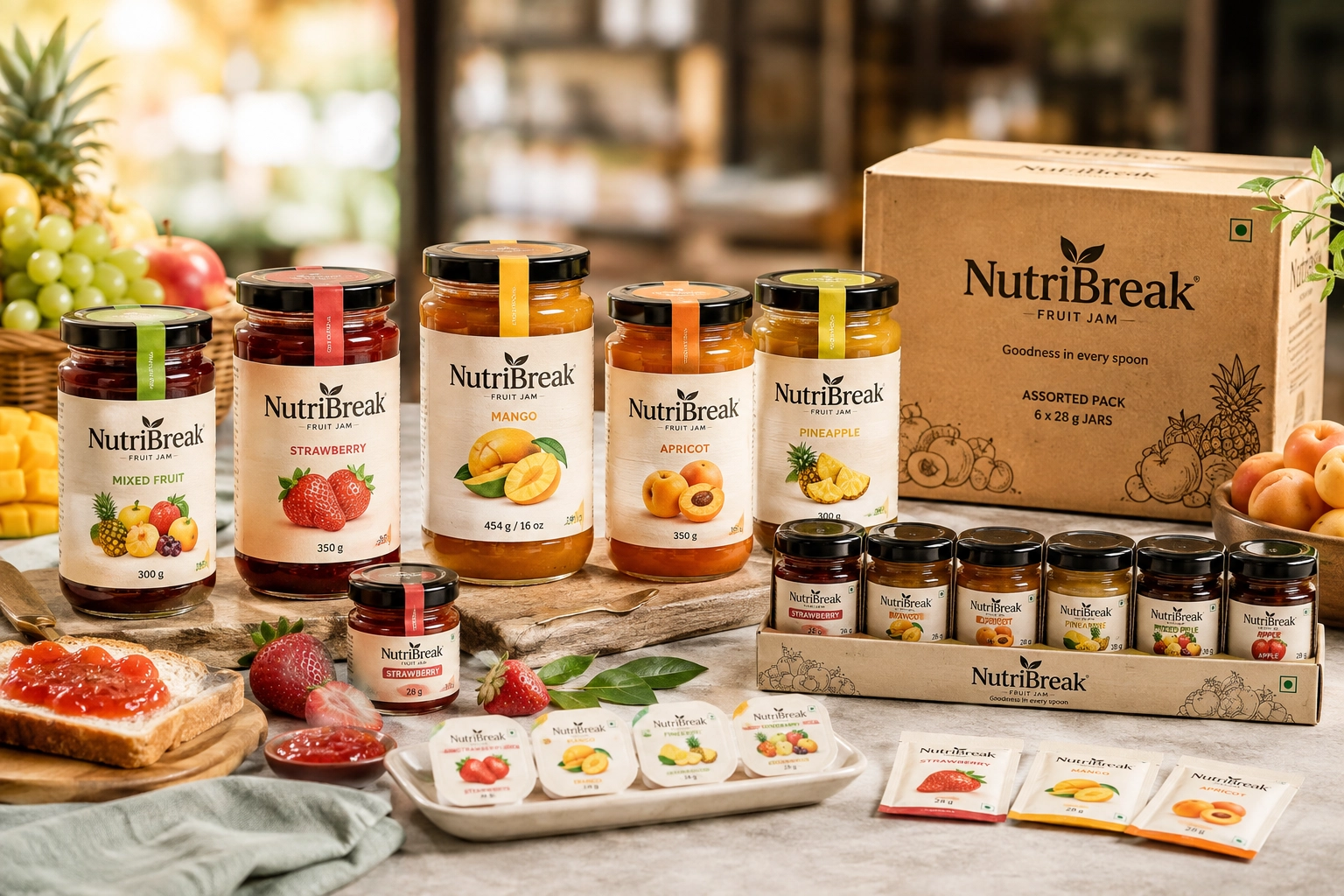
Fruit Jam Manufacturer in India: Strawberry, Mango, Apricot, Pineapple, Apple, Mixed Fruit and More
Fruit jam is a cooked, gelled product of fruit and sweeteners defined by Codex CXS 296-2009. Aspire International manufactures a full range of fruit jams and preserves in Mohali, Punjab, India for private-label brands, importers, retailers, hotels, bakeries and export markets.
Fruit jam is a product of suitable consistency made from whole fruit, pieces, pulp or purée with sweetening agents, cooked to 60–65 % or greater soluble solids under the Codex standard for jams. Aspire International, an FSSC 22000-certified fruit jam manufacturer established in 2021 in Mohali, Punjab, India, produces mixed fruit, strawberry, mango, apricot, pineapple, apple, fig, raspberry, blueberry, blackberry and peach jams and preserves in glass and PET jars, portion cups and pails for retail, private-label, hospitality, foodservice and export buyers.
What is fruit jam, and what flavours does Aspire manufacture?
The Codex definition covers jam, extra jam, jelly and marmalade. Aspire's range spans everyday jams and premium preserves.
Everyday jams
Mixed fruit, strawberry, pineapple, apple and mango jams for retail, institutions and foodservice.
Preserves with fruit pieces
Strawberry, raspberry, apricot, blueberry, blackberry, peach and fig preserves for premium ranges.
Spreads and specials
Fig spread, reduced-sugar spreads and bake-stable fillings developed to brief.
| Flavour | Style options | Natural pectin | Typical channel |
|---|---|---|---|
| Mixed fruit | Jam | Medium | Retail, institutions, foodservice |
| Strawberry | Jam, preserve | Low | Retail, hospitality, bakery |
| Mango | Jam | Medium | South Asia, Gulf, ethnic retail |
| Apricot | Jam, preserve, glaze | Medium | Retail, bakery |
| Pineapple | Jam, preserve | Low | Asia, Gulf, Africa retail |
| Apple | Jam | High | Value retail, base fruit |
| Fig | Preserve, spread | Medium | Gourmet, cheese boards |
| Raspberry / blueberry / blackberry | Preserve | Medium | Premium retail, gourmet |
| Peach | Preserve | Low | Retail, dessert |
Buyer takeaway: one manufacturer for the whole jam range, plus honey, simplifies consolidation into one container.
Who is Aspire International, the company behind this fruit jam page?
Before sourcing fruit jam, buyers want to know who manufactures it, where, and under what food-safety system.
Aspire International is an engineering-led, export-oriented food manufacturing and packaging company based in Mohali, Punjab, India. It was established in 2021 by Ankit Pal Singh, a mechanical engineer whose background spans CAD and 3D modelling, production engineering, industrial design, factory operations, product development, food-safety systems and international marketing.
The business began with food-grade PET jars and bottles and high-strength corrugated shipper cartons for export-oriented food manufacturers, and then expanded from packaging engineering into food manufacturing. That is why Aspire treats the product, container, closure, label, shipper carton, pallet and destination market as one manufacturing system rather than separate decisions.
Manufacturing is supported by company director and mentor Mr S. P. Singh, founder of Ess Pee Quality Products, who brings more than 30 years of packaged-food industry experience. The enterprise was established under the Prime Minister's Employment Generation Programme (PMEGP), implemented through KVIC under India's Ministry of MSME.
“Quality should not depend on chance. It should be engineered into the process.” — Aspire International manufacturing philosophy
Published credentials
- FSSC 22000Certified food-safety management system for honey and fruit jam (stated by the company)
- FSPCA PCQIFounder trained as a Preventive Controls Qualified Individual (US FSMA framework)
- US FDA food facility registrationStated by Aspire International for export to the United States
- APEDA registrationRegistered with India's Agricultural & Processed Food Products Export Development Authority
- PMEGP / KVICEnterprise established under the Prime Minister's Employment Generation Programme
- Manufacturing mentorDirector S. P. Singh, founder of Ess Pee Quality Products, 30+ years in packaged food
Buyers should request current certificate and licence copies directly from Aspire International and verify entity, site, scope and validity.
Where is fruit jam done, and where can it be shipped?
Fruit Jam manufacturing location decides fruit sourcing, freight and labelling regime.
Manufacturing base
Located in the Chandigarh tri-city region, close to Chandigarh International Airport, with road access to the northern Indian dry ports and container corridors used for export consignments.
- Manufacturing, packing and corrugated secondary packaging on one site
- Export-oriented B2B operating model since 2021
- Official website: aspire-world.com
Aspire International manufactures fruit jam in Mohali, Punjab, in northern India. The region has access to Indian fruit supply chains for mango, apple, pineapple, strawberry, apricot and mixed-fruit pulps, and to the sugar and pectin supply that jam production depends on.
For export buyers, Mohali connects by road to the northern dry ports and onward to the western sea ports, and Chandigarh International Airport is nearby for samples and air shipments. Fruit jam is shelf-stable at ambient temperature, which keeps sea freight practical for long routes.
The company's website states that it is developing supply across the United States, Canada, Australia, the Middle East (UAE, Saudi Arabia, Qatar, Oman), Singapore, South Korea, Vietnam, Chile and Nigeria. Jam labelling rules (fruit content, sugar, additives) differ by market and are aligned in the buyer's brief.
Markets Aspire International is developing supply for
“Developing supply across” a market is not the same as verified shipment history to that market. Destination eligibility must be confirmed for the actual product, formula, label and pack.
How Aspire manufactures fruit jam
Four stages from fruit to sealed jar.
Fruit intake
Mixed fruit arrives as blend of pulps and pieces; it is checked against specification and lot-numbered.
Batching and cooking
Fruit, sugar, pectin and acid are weighed to recipe and cooked to the soluble-solids end-point while protecting the deep red-orange colour.
Hot-fill and close
The jam is filled hot into jars or cups and closed so a vacuum forms on cooling.
Label, case, release
Labelled, coded, cased and released with batch records under the FSSC 22000 system.
| Step | Parameter | Mixed fruit-specific note |
|---|---|---|
| Batching | Fruit-to-sugar ratio | Mixed fruit is moderate in natural pectin, so recipes usually add pectin for a reliable set |
| Cooking | Soluble solids, time | Short, controlled cook protects deep red-orange colour and pieces |
| Acidification | pH | Mixed fruit is moderately acidic; acidulant is added to reach the gelling pH |
| Hot fill | Temperature | Pieces distributed evenly across jars |
| Cooling | Profile | Set without floating fruit or syneresis |
For whom is fruit jam from Aspire intended?
Mixed fruit jam serves several channels.
Retail & private label
Own-label fruit jam in glass or PET jars with compliant labels and shelf-ready cases.
- Private-label manufacturing
- Artwork compliance
- Shelf-ready cases
Importers
Finished fruit jam with export documents, often in mixed-flavour consignments.
- Mixed-flavour container loads
- COA, health and origin certificates
- Glass or PET
Hospitality
Portion cups and mini jars of fruit jam for breakfast service.
- 15–30 g portion cups
- Mini glass jars
- Dispenser cartons
Bakery & foodservice
Bulk fruit jam in pails; bake-stable grades on request.
- 1–20 kg pails
- Specification supply
- Lot analysis
| Buyer type | What they usually need | How Aspire responds |
|---|---|---|
| Importer / distributor | Retail jam SKUs with reliable documents | Glass and PET jars, mixed-flavour consignments, COA and origin documents |
| Supermarket / retail chain | Own-label jam range | Private-label manufacturing, shelf-ready cases, artwork coordination |
| Hotel, airline, catering | Portion jams and mini jars | Portion cups, mini jars, dispenser cartons |
| Bakery / food manufacturer | Bake-stable fillings and bulk jam | Pails and tubs to specification |
| Brand start-up | A partner to develop recipe and pack | Recipe development, trial batches, packaging engineering |
What fruit jam options can you specify?
Style, fruit content, sugar level, format and brand route are all selectable.
Jam, preserve or spread
Smooth mixed fruit jam, mixed fruit preserve with small pieces of several fruits, or a fruit-forward spread.
Standard or reduced sugar
Codex jam soluble solids, or reduced-sugar recipes to brief where the market allows.
Standard or extra fruit
Codex general 45 % minimum for jam; higher fruit content for premium positioning.
Retail jars
Glass and PET jars from 200 g to 1 kg.
Portions and pails
15–30 g cups, mini jars, 1–20 kg pails.
Private label or Aspire brand
Manufactured under your brand or supplied as Aspire-branded.
| Option | Best for | Consideration |
|---|---|---|
| Mixed fruit jam (smooth) | Everyday retail, foodservice | Consistent spreadability |
| Mixed fruit preserve (pieces) | Premium retail, gourmet | Fruit piece integrity |
| Mixed fruit spread (fruit-forward) | Health and natural positioning | Softer set; check destination naming rules |
| Bake-stable mixed fruit filling | Bakeries | Higher solids; specification-led |
What is the process from enquiry to shipped fruit jam?
A private-label project moves through these stages.
Brief
Style, fruit content, sugar level, format, market and volume.
Recipe and samples
Mixed fruit recipe developed and samples approved.
Artwork and compliance
Label content verified for the destination.
Packaging
Jar, lid, divider and shipper finalised.
Production
Batching, cooking, hot-fill, packing with records.
Documents and dispatch
COA, health, origin, packing list, invoice.
| Stage | Aspire | Buyer |
|---|---|---|
| Brief | Options, quotation | Requirements |
| Recipe | Development, samples | Approval |
| Artwork | Compliance check | Assets, approval |
| Production | Manufacture, records | Inspection if required |
| Export | Documents, dispatch | Clearance |
What quality controls apply to fruit jam?
Controls follow Codex CXS 296-2009 and the buyer's specification, with attention to mixed fruit's medium pectin and medium acidity.
Control points
- ✓Fruit and ingredient intake
Fruit pulp or pieces, sugar, pectin and acid are received against specification and supplier records.
- ✓Recipe batching
Ingredients are weighed to the approved recipe so fruit content and sugar ratio are repeatable batch to batch.
- ✓Cook end-point control
Soluble solids (Brix) and pH are measured at the cook end-point to reach the target set and shelf-stable range.
- ✓Hot fill and seal
Jars are filled hot, closed and inverted or cooled under a controlled procedure so the seal and vacuum are consistent.
- ✓Cooling, coding and inspection
Cooling, label and code checks, and visual inspection happen before cases are closed.
- ✓Release and retention
Retained samples, batch records and release approval sit under the FSSC 22000 food-safety system.
Codex jam reference values (CXS 296-2009)
Bars show Codex minimums or ranges as a visual reference.
| Parameter | Why it matters | Reference |
|---|---|---|
| Soluble solids (Brix) | Decides set, sweetness and shelf stability; Codex jam 60–65 % or greater | Codex CXS 296-2009 |
| Fruit content | Codex minimum 45 % for standard jam (lower for specified fruits); declared on label in many markets | Codex CXS 296-2009 |
| pH / acidity | Pectin gel forms in a narrow pH range; also limits spoilage organisms | Recipe specification |
| Pectin and set | Set strength checked so the jam spreads without syneresis | Recipe specification |
| Hot-fill temperature and vacuum | Ensures container sterility and lid vacuum for shelf-stable jam | Process specification |
| Seal and vacuum check | Button-down lids and torque confirm a sealed jar | Packing control |
| Foreign matter and colour | Visual inspection for pieces, stems and colour uniformity | Packing control |
| Label declaration | Fruit content, sugar, allergens, net quantity, dates, origin | Destination law |
What packaging is available for fruit jam?
Formats for fruit jam across retail, hospitality, foodservice and export, with cases designed in-house.
Glass & PET jars
Classic jam jars with lug or twist-off closures, and lightweight PET jars where the channel prefers plastic.
Portion cups & mini jars
Single-serve portions for hotels, airlines, breakfast buffets and room service.
Catering tubs & pails
Larger tubs and pails for bakeries, cafés, central kitchens and institutional catering.
Corrugated shippers
In-house 3-ply and 5-ply shipper cartons, retail-ready and shelf-ready cases built around jar size and case count.
| Format | Typical use | Closure / seal | Case & export consideration |
|---|---|---|---|
| Glass jar (lug / twist-off) | Retail shelf, gourmet, gifting | Vacuum lug closure | Dividers, 5-ply shippers and shrink options for export routes |
| PET jar | Value retail, ethnic retail, club packs | Screw cap with liner | Lower weight and breakage; lower freight cost per case |
| Portion cup | Hotels, airlines, catering | Heat-sealed lidding film | Sleeves or dispenser trays inside master carton |
| Catering tub / pail | Bakeries, cafés, central kitchens | Tamper-evident lid | Palletised; handling weight defined with the buyer |
| Retail-ready case | Supermarket shelf replenishment | n/a | Tear-open shelf-ready carton designed in-house to jar dimensions |
Fruit Jam Manufacturing Company in India for Retail, Private Label and Export
A buyer searching for a fruit jam manufacturer usually needs more than a jar of jam. The manufacturing decision includes formulation, fruit content, soluble solids, texture, filling method, pack compatibility, label compliance, batch traceability, secondary packaging and export readiness.
Fruit jam production
Aspire International manufactures fruit jam from defined recipes and ingredient specifications, with controlled batching, cooking, hot filling, closure, cooling, coding and batch release.
Contract fruit jam manufacturing
For brand owners and procurement teams, the product can be developed around the required flavour, fruit presentation, sweetness, pack size, channel and destination market.
Fruit jam exporter from India
Export supply requires the food and its packaging to work together: jar or cup, closure, label, divider, shipper carton, pallet configuration and destination documentation.
Useful buyer specification: identify the fruit/flavour, whether the target is jam, preserve or spread, desired fruit content, sweetness or Brix target, texture, pack size, annual volume, destination market and private-label requirements. This gives a manufacturer enough information to develop a commercially meaningful sample and quotation.
Private Label Fruit Jam Manufacturer for Your Brand
Private label fruit jam means the jam is manufactured and packed by a food manufacturer but sold under the buyer's own brand, retailer brand, distributor label or foodservice identity. The commercial work therefore covers both the recipe and the finished retail pack.
What the buyer can define
- Fruit flavour or mixed-fruit profile
- Jam, preserve, spread or specification-led filling
- Fruit content and sweetness target
- Glass jar, PET jar, mini jar, portion cup or bulk pail
- Net weight, case count and carton style
- Brand artwork and destination-market label content
What the manufacturing project must control
- Approved formula and ingredient specification
- Packaging compatibility with hot filling and distribution
- Lot coding and traceability
- Finished-product checks and release records
- Artwork version control
- Export or domestic documentation applicable to the order
Private label fruit jam project flow
| Stage | Commercial question | Practical output |
|---|---|---|
| 1. Product brief | What fruit jam do you want to sell? | Flavour, style, sweetness, fruit presentation and target market |
| 2. Pack brief | How will the product be sold? | Jar/cup/pail, net weight, closure and case configuration |
| 3. Sample approval | Does the sensory profile meet the brand target? | Approved reference sample and product specification |
| 4. Artwork | What must the label communicate? | Buyer-approved, market-appropriate artwork file |
| 5. Manufacture | Can every batch be reproduced and traced? | Production, inspection, coding and release records |
| 6. Dispatch | How must the order travel? | Shipper, pallet and order documentation |
Bulk Fruit Jam Supplier for Bakery, Foodservice and Hospitality
Bulk fruit jam is purchased differently from retail jam. The buyer is usually evaluating functionality, pack handling, application consistency and delivered cost rather than only shelf appearance.
Bakery fruit jam and fillings
For cakes, pastries, biscuits, doughnuts and other bakery applications, buyers may require a specification based on spreadability, bake performance, water activity or solids, fruit pieces and processing behaviour. A bakery filling should be qualified for the actual process rather than assumed to behave like retail jam.
Foodservice fruit jam
Restaurants, cafés, caterers and institutional kitchens generally prioritise easy dispensing, repeatable texture, pack hygiene and economical larger formats.
Hotel and breakfast jam
Hospitality supply can use single-serve fruit jam portions or mini jars where portion control, table presentation, hygiene and rapid service matter.
Important technical distinction: Codex CXS 296-2009 applies to jams, jellies and marmalades offered for direct consumption, catering or repacking, but it does not apply to products clearly intended for further processing such as bakery manufacture. Industrial fruit fillings should therefore be specified according to their actual end use and applicable market rules rather than marketed solely by reference to the retail jam standard.
Fruit Jam Flavours: Mixed Fruit, Strawberry, Mango, Apricot, Pineapple, Apple and More
Flavour pages and product listings often treat every jam as the same recipe with a different name. In manufacturing, each fruit behaves differently in colour, acidity, natural pectin, pulp structure and flavour intensity, so formulation and process conditions need to be adjusted accordingly.
Mixed Fruit Jam
Designed as a balanced fruit blend rather than a single-fruit profile. The recipe should define which fruits contribute body, acidity, aroma, colour and recognisable pieces.
Strawberry Jam
A familiar retail and hospitality flavour where bright fruit character, red colour, seed/piece presentation and controlled set are important quality cues.
Mango Jam
Mango contributes strong pulp body and characteristic tropical flavour. The final texture and sweetness should be adjusted to the intended market and fruit content.
Apricot Jam
Apricot jam and preserve can serve retail as well as bakery and glaze applications, with the required smoothness or fruit-piece character defined in the specification.
Pineapple Jam
Pineapple requires attention to fibre/piece size, acidity and flavour retention so the finished jam remains recognisably pineapple after cooking.
Apple Jam
Apple can provide a clean fruit profile and useful natural pectin contribution. It can be manufactured as a standalone flavour or used as a component of mixed-fruit formulations where declared and appropriate.
Additional premium fruit-jam and preserve directions can include fig, peach and berry profiles. The correct formulation depends on fruit form, customer brief, ingredient availability, destination requirements and sensory target.
What Is Fruit Jam Made Of? Fruit, Sweeteners, Pectin, Acid and Process Control
Fruit jam is not created by sugar alone. Its final body, spreadability, flavour and stability come from the interaction of fruit ingredients, soluble solids, acidity, pectin system, thermal process and packaging.
| Component | Manufacturing function | Buyer question |
|---|---|---|
| Fruit, pulp or purée | Provides fruit identity, flavour, colour, solids and texture | Which fruit form and fruit content are required? |
| Sweetening ingredients | Contribute sweetness and soluble solids and influence gel structure | What sweetness/solids target and market positioning are intended? |
| Pectin system | Helps form and control gel structure where needed | Should the product be soft-spreading, firm, piece-holding or application-specific? |
| Acid / acidity adjustment | Supports flavour balance and pectin performance and contributes to product stability | What pH/acidity specification is approved for the formula? |
| Optional permitted ingredients | May support flavour, colour, process or preservation depending on product and regulation | What is permitted and declared in the destination market? |
| Heat process | Concentrates the batch and develops the target product condition | How will time/temperature be controlled to avoid unnecessary quality loss? |
| Container and closure | Protect the finished product after filling | Is the pack compatible with fill temperature, seal system, storage and transport? |
Codex clarification: CXS 296-2009 defines jam as a product brought to suitable consistency from whole fruit, fruit pieces, pulp and/or purée with sweetening ingredients, with or without added water. The standard gives fruit-content requirements and soluble-solids criteria for covered products. Reduced-sugar products are excluded from its scope, so they must be developed and named against the applicable destination-market rules rather than treated as ordinary Codex jam by default.
Fruit Jam vs Fruit Preserve vs Fruit Spread vs Jelly: What Is the Difference?
These terms are often used casually by consumers, but a manufacturer and private-label buyer should treat product naming as a formulation and regulatory decision.
| Product term | Typical physical idea | Commercial interpretation |
|---|---|---|
| Fruit jam | Fruit ingredients cooked with sweetening ingredients to a suitable spreadable consistency | Core retail category; formulation and name should meet the relevant legal standard in the destination market |
| Fruit preserve / conserve | Often associated commercially with a fruit-forward product and more visible fruit pieces | Under Codex, preserve/conserve used for products covered by the standard must comply with jam and/or extra-jam requirements |
| Fruit spread | Broad commercial term often used for fruit-forward or different-solids products | Naming and composition depend strongly on local regulation; it should not be assumed to be legally interchangeable with jam |
| Jelly | Semi-solid gel made from fruit juice and/or aqueous fruit extracts rather than fruit pulp/pieces | Different texture and ingredient architecture from jam |
| Bakery fruit filling | Application-driven filling designed for processing performance | May require bake stability or other functional properties and is not automatically the same product as retail jam |
For consumers
The meaningful differences are flavour, fruit presentation, sweetness and spreadability.
For B2B buyers
The important differences are legal product name, fruit-content basis, soluble-solids target, application, ingredient declaration, process, packaging and destination-market compliance.
Fruit Jam Packaging Sizes for Retail, Hotels, Foodservice and Bulk Supply
The correct fruit jam pack depends on the consumption occasion. Aspire International's packaging-led manufacturing model allows the food specification and pack architecture to be considered together rather than as separate purchasing decisions.
Retail fruit jam jars
Glass or PET formats can be configured for supermarket, grocery, ethnic retail and private-label ranges. Net weight, jar geometry, closure, case count and shelf presentation should be selected together.
Single-serve fruit jam
Portion cups and mini jars are suited to hotel breakfast, catering, airlines, travel, institutional service and controlled portions.
Bulk fruit jam packs
Tubs and pails serve bakery, café, central-kitchen and foodservice requirements where dispensing efficiency and handling weight matter more than retail shelf appearance.
Packaging-engineering advantage: a private-label project should qualify the primary container, lid or lidding film, tamper evidence, label, divider, corrugated shipper and pallet plan as one distribution system. That reduces avoidable breakage, movement, label damage and poor case utilisation during long-distance logistics.
How to Choose a Fruit Jam Manufacturer: B2B Buyer Checklist
A serious sourcing comparison should evaluate the manufacturer's ability to control the product specification and supply system, not just the quoted price per jar.
Product and process questions
- Can the manufacturer work to an approved recipe and specification?
- How are fruit ingredients, sugar, pectin and acid controlled at intake and batching?
- Which parameters are checked during cooking and filling?
- How are coding, traceability, retained samples and batch release managed?
- Can the same manufacturer support multiple fruit jam flavours?
Commercial and export questions
- Can the supplier manufacture under private label?
- Which packaging formats and case configurations are available?
- Can artwork and destination-market labelling be coordinated?
- What documents can be supplied with the shipment?
- How are trial orders, scale-up and repeat orders handled?
Search terms this page answers in commercial context
Fruit jam manufacturer in India · fruit jam manufacturing company · private label fruit jam manufacturer · contract fruit jam manufacturing · bulk fruit jam supplier · foodservice jam supplier · hotel jam portions · mixed fruit jam manufacturer · strawberry jam manufacturer · mango jam manufacturer · apricot jam manufacturer · pineapple jam manufacturer · apple jam manufacturer · fruit jam exporter India.
Common misconceptions about fruit jam
Fruit Jam is the same everywhere.
Fruit content, sugar level, pieces and colour retention vary widely; the specification defines the product.
Preserve, jam and spread are just marketing words.
They describe fruit presentation and set; in many markets the names are regulated by fruit content and solids.
Mixed fruit jam needs preservatives.
Correct soluble solids, pH, hot fill and a vacuum lid give shelf stability; preservatives are optional and market-dependent.
Only mixed fruit from one country can make good jam.
Quality depends on fruit form, recipe and process control; mixed fruit is sourced to specification.
Fruit Jam: frequently asked questions
What is fruit jam?
A cooked, gelled product of fruit (whole, pieces, pulp or purée) and sweeteners at 60–65 % or greater soluble solids, as defined by Codex CXS 296-2009.
Who manufactures fruit jam in India?
Aspire International manufactures fruit jam in Mohali, Punjab, India under an FSSC 22000-certified system for private-label, retail, hospitality and export buyers.
Which fruit jam flavours does Aspire manufacture?
Mixed fruit, strawberry, mango, apricot, pineapple, apple, fig, raspberry, blueberry, blackberry and peach jams and preserves, plus fig spread and applesauce.
Can I get fruit jam under my own brand?
Yes. Private-label manufacturing with packaging development and label compliance is a core service.
What packaging is available for fruit jam?
Glass and PET jars, portion cups, mini jars, tubs and pails, and export cases designed in-house.
Is reduced-sugar fruit jam available?
Reduced-sugar and fruit-forward spread recipes can be developed where the destination market's naming rules allow.
What is the shelf life of fruit jam?
Defined in the specification with supporting data; hot-filled, vacuum-sealed jam is ambient shelf-stable.
How do I order fruit jam?
Email aspireinternationalfactory@gmail.com or use the verified WhatsApp link with style, format, volume and destination.
Does Aspire International offer private label fruit jam manufacturing?
Yes. The private-label workflow can cover product brief, recipe and sample approval, packaging selection, artwork coordination, manufacturing, coding, case packing and order documentation according to the agreed project scope.
Can Aspire supply bulk fruit jam for bakery and foodservice?
Bulk fruit jam and specification-led fruit fillings can be discussed for bakery, foodservice and institutional applications. Industrial fillings should be qualified for the intended process and destination requirements rather than assumed to be identical to retail jam.
What is the difference between jam, preserve and fruit spread?
Jam is a defined fruit-and-sweetener product brought to a suitable consistency. Preserve or conserve may be used for products covered by the Codex jam standard when its requirements are met, while fruit spread is a broader market term whose legal use depends on the destination country's rules.
Which information should I send for a fruit jam quotation?
Send the required flavour, product style, fruit content or quality target, pack type and net weight, private-label requirement, order volume, annual forecast and destination market. This allows the manufacturing and packaging brief to be evaluated together.
Fruit Jam Standards and Specification Notes for International Buyers
International sourcing works best when a commercial product brief is separated from the legal standard that applies in the destination market.
Codex CXS 296-2009
The Codex Standard for Jams, Jellies and Marmalades defines covered product types and sets composition and quality provisions. For jam, the general fruit-content requirement is at least 45% of finished product, with lower specified percentages for certain named fruits. Covered jam/jelly/marmalade products have soluble-solids criteria defined by the standard.
Destination-market compliance
Codex is an important international reference, but the product placed on a national market must also comply with the applicable local law for naming, ingredients, additives, nutrition information, claims, net quantity, date coding, allergen declarations and other label requirements.
Correction worth noting: 35% should not be read as a universal “reduced-fruit jam” minimum under Codex. In CXS 296-2009, 35% is one of the fruit-content exceptions applying to specific fruits such as mango and certain berries. The same Codex standard also excludes reduced-sugar products from its scope. A reduced-sugar fruit spread or similar product should therefore be formulated and named according to the rules applicable in its target market.
Need fruit jam manufactured to your specification?
Send your style, fruit content, format, market and volume. Aspire International will develop the mixed fruit recipe, provide samples and quote.
- Emailaspireinternationalfactory@gmail.com
- Phone+91 97800 64020 (India)
- WhatsAppVerified WhatsApp link
- Factory130 MK Technology Park, Mohali, Punjab, India
Send us this and we can quote faster
- Fruit and style: jam, preserve with fruit pieces, spread, or reduced-sugar recipe; flavours required
- Pack format and net weight (e.g. 350 g glass jar, 1 kg PET, 15–28 g portion cups, catering pails)
- Brand route: your private label (artwork ready or to be developed) or Aspire-developed label
- Order size and forecast: trial quantity, first order and expected annual volume
- Destination market so labelling, fruit-content declarations and additives can be aligned to local rules
- Documents you need: specification sheet, certificate of analysis, health certificate, certificate of origin