
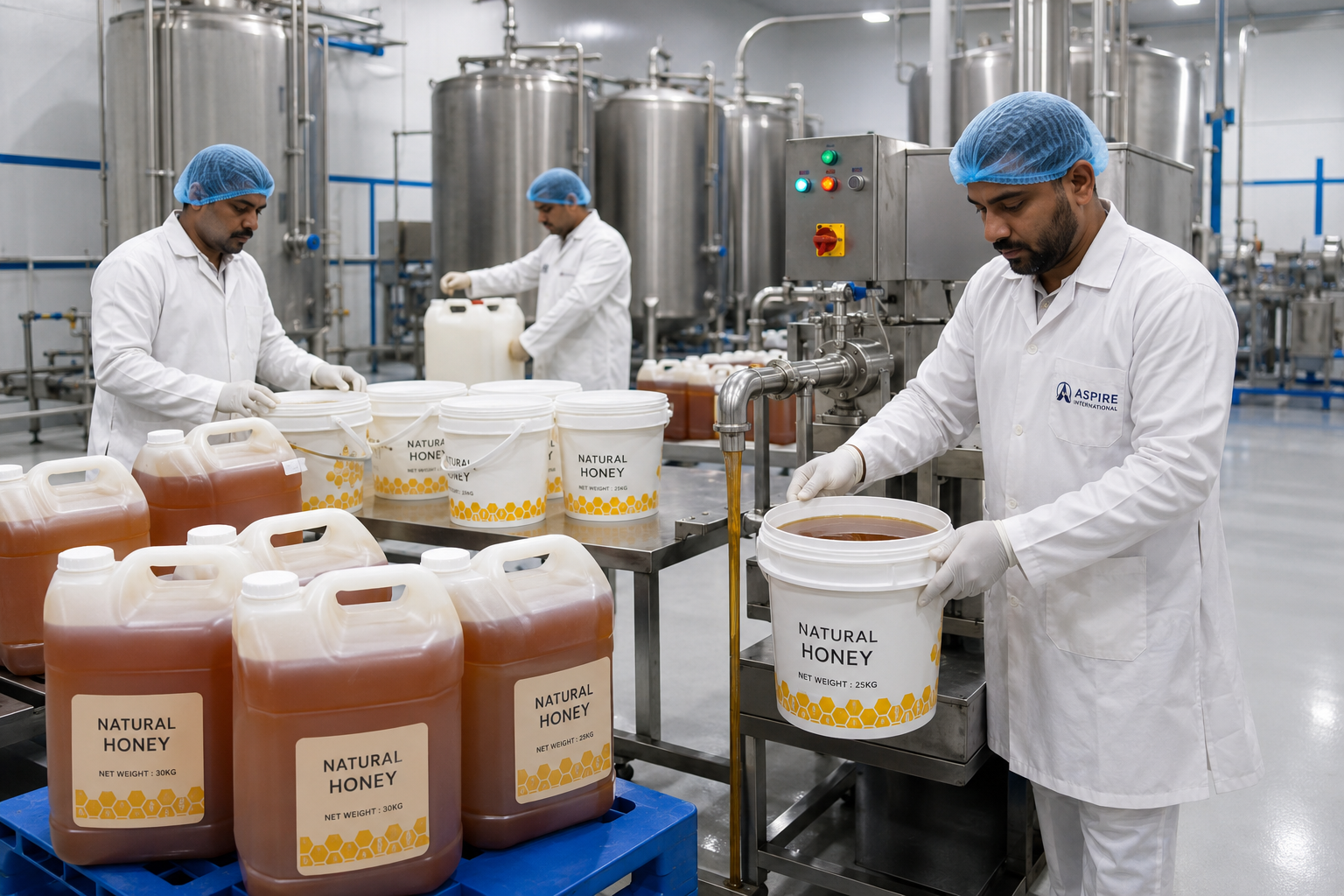
Honey Packing Services in India for Retail, Foodservice, Bulk and Private Label
Honey packing is the controlled conversion of processed honey into sealed, labelled, coded and case-packed units that survive shipping and sell on a shelf. Aspire International packs honey in Mohali, India for importers, retailers, hospitality groups and private-label brands.
Honey packing is the industrial process of filling processed honey into retail jars, squeeze bottles, portion packs or bulk containers, sealing and labelling them, and casing them for distribution. Aspire International, an FSSC 22000-certified honey packer established in 2021 in Mohali, Punjab, India, offers honey packing for private-label, retail, foodservice, bulk and export buyers, with in-house corrugated shipper design and export documentation.
What does honey packing actually involve?
Buyers often use “honey packing”, “honey bottling” and “honey filling” interchangeably. In practice, packing is the last, most visible stage of a longer chain and it decides whether the honey arrives clean, sealed and legally labelled.
Filling
Warm, strained honey is dosed by weight or volume into the primary pack. Viscosity, temperature and nozzle design control accuracy and drip.
Sealing and closing
Caps are torqued, liners or induction seals applied, and packs are checked for leaks. This is where most complaints are prevented.
Labelling, coding, casing
Labels, batch codes and best-before dates are applied, packs are cased in corrugated shippers and palletised for the destination.
| Term | Meaning | What a buyer should ask |
|---|---|---|
| Honey packing | Filling, sealing, labelling and casing processed honey | Which formats, fill accuracy, seal method, case design |
| Honey bottling | Packing into bottles, usually squeeze or PET | Closure type, drip control, viscosity handling |
| Honey processing | Straining, moisture control, warming before packing | Temperature profile, HMF and diastase after processing |
| Contract / co-packing | Packing a buyer's honey or recipe under agreement | Division of responsibility, supplied materials, records |
| Private-label packing | Packing under the buyer's brand | Artwork approval, label compliance, MOQ, lead time |
Buyer takeaway: a packer who also designs the shipper carton and understands the destination label rules removes two of the most common causes of rejected honey consignments: leaking packs and non-compliant labels.
Who is Aspire International, the company behind this honey packing page?
Before buying a packing service, most buyers want to know who owns the factory, what it is certified for, and whether packaging is a core skill or an afterthought.
Aspire International is an engineering-led, export-oriented food manufacturing and packaging company based in Mohali, Punjab, India. It was established in 2021 by Ankit Pal Singh, a mechanical engineer whose background spans CAD and 3D modelling, production engineering, industrial design, factory operations, product development, food-safety systems and international marketing.
The business began with food-grade PET jars and bottles and high-strength corrugated shipper cartons for export-oriented food manufacturers, and then expanded from packaging engineering into food manufacturing. That is why Aspire treats the product, container, closure, label, shipper carton, pallet and destination market as one manufacturing system rather than separate decisions.
Manufacturing is supported by company director and mentor Mr S. P. Singh, founder of Ess Pee Quality Products, who brings more than 30 years of packaged-food industry experience. The enterprise was established under the Prime Minister's Employment Generation Programme (PMEGP), implemented through KVIC under India's Ministry of MSME.
“Quality should not depend on chance. It should be engineered into the process.” — Aspire International manufacturing philosophy
Published credentials
- FSSC 22000Certified food-safety management system for honey and fruit jam (stated by the company)
- FSPCA PCQIFounder trained as a Preventive Controls Qualified Individual (US FSMA framework)
- US FDA food facility registrationStated by Aspire International for export to the United States
- APEDA registrationRegistered with India's Agricultural & Processed Food Products Export Development Authority
- PMEGP / KVICEnterprise established under the Prime Minister's Employment Generation Programme
- Manufacturing mentorDirector S. P. Singh, founder of Ess Pee Quality Products, 30+ years in packaged food
Buyers should request current certificate and licence copies directly from Aspire International and verify entity, site, scope and validity.
Where is honey packing done, and where can it be shipped?
Location matters for honey packing because it sets the raw-material belt, the road-to-port distance and the export documentation regime.
Manufacturing base
Located in the Chandigarh tri-city region, close to Chandigarh International Airport, with road access to the northern Indian dry ports and container corridors used for export consignments.
- Manufacturing, packing and corrugated secondary packaging on one site
- Export-oriented B2B operating model since 2021
- Official website: aspire-world.com
Aspire International's honey operation is in Mohali, Punjab, in northern India. Punjab and the neighbouring states of Haryana, Himachal Pradesh, Uttarakhand and Uttar Pradesh form one of India's major beekeeping belts, where migratory apiaries follow mustard, eucalyptus, litchi, sunflower and multiflora blooms through the year.
For international buyers, the practical question is not only where honey is packed but how it reaches the port. Mohali connects by road to the northern dry ports and onward to Mundra and Nhava Sheva for sea freight, and Chandigarh International Airport is close by for samples and air consignments.
The company's published website states that it is developing supply across the United States, Canada, Australia, the Middle East (UAE, Saudi Arabia, Qatar, Oman), Singapore, South Korea, Vietnam, Chile and Nigeria. Each destination has its own honey rules on labelling, residues and origin declaration, which Aspire aligns to the buyer's brief.
Markets Aspire International is developing supply for
“Developing supply across” a market is not the same as verified shipment history to that market. Destination eligibility must be confirmed for the actual product, formula, label and pack.
How Aspire International packs honey, step by step
A four-stage view of the packing line, from processed honey to a palletised export case.
Honey ready for packing
Strained, moisture-checked honey is held warm so it flows evenly and fills accurately without air pockets.
Fill and close
Jars, bottles or portions are filled to the declared net quantity, capped and sealed; fill weight and torque are checked at intervals.
Label, code, inspect
Labels are applied, batch and best-before codes printed, and packs inspected for leaks, label position and cleanliness.
Case, palletise, ship
Packs go into in-house designed 3-ply or 5-ply shippers with dividers, are palletised and documented for export.
| Packing stage | Control | Record kept |
|---|---|---|
| Pre-fill | Honey temperature, moisture, clean containers | Batch sheet, container lot |
| Filling | Net weight checks against declared quantity | Fill-weight log |
| Closing | Cap torque, liner / induction seal, leak check | Closure check log |
| Labelling | Correct artwork version, code legibility, date format | Label reconciliation |
| Casing | Case count, divider fit, pallet pattern | Packing list, pallet map |
For whom is honey packing from Aspire International intended?
Honey packing is bought by very different customers. The tabs below show how the service changes for each.
Importers & distributors
Importers need repeatable retail SKUs, predictable case dimensions and complete export documents so customs and retail customers accept every consignment.
- Standard retail jars, bottles and squeeze formats
- Mixed-SKU container loading plans
- Certificate of analysis, origin and health certificates
Retail & private label
Supermarkets and brand owners want honey packed under their own label with artwork control, barcodes and shelf-ready cases.
- Private-label honey packing
- Artwork and label compliance coordination
- Shelf-ready and retail-ready case design
Hospitality & foodservice
Hotels, airlines and café chains want portion control, hygiene and presentation.
- Single-serve portions and blisters
- Honey spoons and mini jars
- Squeeze bottles for tables and kitchens
Industrial & bulk
Bakeries, cereal and confectionery makers buy honey as an ingredient in larger containers to a specification.
- Buckets, jerrycans and drums
- Specification-based supply with analysis
- Palletised, documented consignments
| Buyer type | What they usually need | How Aspire responds |
|---|---|---|
| Importer / distributor | Consistent retail SKUs, competitive landed cost, documents | Retail jars and squeeze packs, export-ready cases, COA and origin documents |
| Supermarket / retail chain | Own-label honey with reliable replenishment | Private-label manufacturing, shelf-ready cases, barcode and artwork coordination |
| Hotel, airline, café chain | Portion control and presentation | Single-serve portions, blisters, honey spoons, mini jars |
| Food manufacturer / bakery | Bulk honey to specification | Buckets, jerrycans, drums with specification and analysis |
| Brand start-up | A partner who can develop product and pack from scratch | Product development, packaging engineering, small trial runs |
What honey packing options can you choose from?
The right option depends on channel, price point, destination and how the honey will be used. Aspire develops both conventional and distinctive formats.
PET honey jars and bottles
Lightweight, transparent and practical for mainstream supermarket honey; conventional, shaped and family sizes.
Glass honey jars
For gourmet, traditional and gift positioning where weight, clarity and shelf presence matter.
Squeeze bottles
Upright and inverted formats, conical profiles and bear-style bottles matched to viscosity and closure.
Single-serve packs
Portion packs, blister concepts and honey-spoon formats for hotels, airlines, cafés and hampers.
Family and club packs
Larger retail formats for household, club-store, ethnic retail and wholesale channels.
Foodservice and industrial
Buckets, jerrycans and drums for kitchens, bakeries, institutions and manufacturers.
| Option | Typical net quantities | Best for | Note |
|---|---|---|---|
| PET jar | 250 g – 1 kg | Supermarket, e-commerce | Low breakage, lower freight |
| Glass jar | 250 g – 1 kg | Gourmet, gifting | Heavier cases, premium look |
| Squeeze bottle | 200 g – 750 g | Family, foodservice tables | Drip-control closure |
| Portion / blister / spoon | 7 g – 30 g | Hospitality, airlines | High units per case |
| Bucket / jerrycan / drum | 5 kg – 300 kg | Bakery, industry | Specification supply |
What is the full process from enquiry to shipped honey?
A typical private-label or contract honey packing project moves through these stages.
-
Enquiry and brief
You share the format, net weight, market, brand route and volume. Aspire replies with questions, options and an indicative quotation.
Days
-
Specification and samples
A product specification is agreed; samples of honey and pack are provided for approval.
Approval
-
Artwork and compliance
Label artwork is checked for destination requirements: name, origin, net quantity, date, barcode.
Buyer sign-off
-
Packaging development
Primary pack, closure, divider and shipper carton are finalised and tested for stacking and transit.
In-house
-
Production and packing
Honey is processed, filled, sealed, labelled and cased under the FSSC 22000 system with batch records.
Scheduled
-
Documents and dispatch
COA, health certificate, certificate of origin, packing list and invoice are issued and the consignment is dispatched.
Export
| Stage | Aspire responsibility | Buyer responsibility |
|---|---|---|
| Brief | Options, feasibility, quotation | Format, market, volume |
| Specification | Honey analysis, pack drawings | Approval of spec and samples |
| Artwork | Compliance check, print coordination | Brand assets, final approval |
| Production | Processing, packing, records | Payment schedule, inspection if required |
| Export | Documents, loading, dispatch | Import clearance, distribution |
What quality controls apply to honey packing?
Packing cannot fix poor honey, but poor packing can ruin good honey. Controls therefore cover the honey itself, the container and the seal.
Control points
- ✓
Raw honey intake
Each incoming lot is checked for moisture, appearance, odour, foreign matter and documentation before it is accepted into the process.
- ✓
Filtration and straining
Wax, bee parts and debris are removed under controlled conditions without over-heating the honey.
- ✓
Moisture control
Moisture is measured and held under the Codex limit to reduce fermentation risk during storage and shipping.
- ✓
Container and closure integrity
Fill weight, cap torque, liner seal and leak checks are part of the packing controls.
- ✓
Coding and traceability
Batch codes, best-before dates and lot records connect every case back to its raw-material intake.
- ✓
Release and retention
Retained samples and release records support customer complaints and audits under the FSSC 22000 system.
Codex honey reference values (CXS 12-1981)
Bars show the Codex Alimentarius limit or minimum for each parameter as a visual reference. Aspire works to the buyer's approved specification, which may be tighter.
| Parameter | Why it matters | Reference |
|---|---|---|
| Moisture (≤ 20 %) | High moisture lets natural yeasts ferment the honey in the jar or drum | Codex CXS 12-1981 |
| HMF (≤ 40 mg/kg) | Rises with over-heating and long hot storage; an indicator of freshness and gentle processing | Codex CXS 12-1981 (80 mg/kg tropical origin) |
| Diastase (≥ 8 Schade) | Natural enzyme reduced by heat; supports the claim that honey was not overheated | Codex CXS 12-1981 |
| Sucrose (≤ 5 g/100 g) | Helps show the honey has fully matured and has not been adulterated with sugar syrup | Codex CXS 12-1981 |
| Water-insoluble solids (≤ 0.1 g/100 g) | Measures wax, pollen debris and foreign matter after straining | Codex CXS 12-1981 |
| Authenticity testing | Importers in the US, EU and Gulf increasingly ask for C4 sugar, NMR or LC-IRMS screening | Buyer / destination requirement |
| Residues and contaminants | Antibiotics, pesticides and heavy metals are checked against destination limits | Destination regulation |
| Label declaration | Country of origin, net quantity, best-before and product name must comply | Codex + destination law |
What packaging is available for honey packing?
Aspire International started as a packaging company, so pack engineering is native to its honey packing service. Every format is matched with a closure, divider and corrugated shipper designed in-house.
PET & glass jars
Food-grade PET and glass jars in household sizes, with label panels designed for private-label artwork.
Squeeze bottles
Upright, inverted, conical and shaped squeeze formats matched to honey viscosity and closure behaviour.
Portions, blisters & spoons
Portion packs, blister concepts and honey-spoon formats for hospitality, airlines, cafés and hampers.
Buckets, jerrycans & drums
Larger commercial containers for bakeries, food manufacturers, institutions and re-packers.
| Format | Typical use | Closure / seal | Case & export consideration |
|---|---|---|---|
| PET jar / bottle | Mainstream supermarket honey | Screw cap, induction or liner seal | Light, transparent, low breakage; case count and divider design by jar geometry |
| Glass jar | Premium, gourmet, traditional positioning | Metal lug or screw cap with liner | Heavier cases; dividers and 5-ply shippers for long sea routes |
| Squeeze bottle | Convenience and foodservice tables | Flip-top or valve closure | Closure selected for honey viscosity and destination temperature |
| Portion pack / blister / honey spoon | Hotels, airlines, hampers | Heat seal or blister seal | High unit count per case; display or dispenser cartons |
| Bucket / jerrycan / drum | Bakeries, manufacturers, re-packers | Tamper-evident lid or bung | Palletised; net weight and liner specified in the buyer brief |
Common misconceptions about honey packing
Honey packing is just pouring honey into jars.
Fill accuracy, temperature, closure torque, seal integrity, label compliance and case strength each have their own controls and records.
Any packer can put my label on honey.
Private-label packing needs artwork compliance checks for the destination market and traceable batch records behind the label.
Plastic packs are always lower quality than glass.
Food-grade PET is widely used for mainstream honey; glass suits premium positioning. The right choice depends on channel, freight and breakage risk.
Crystallised honey in the jar means it was packed badly.
Crystallisation is natural for many honeys and depends on glucose-to-fructose ratio and storage temperature, not on packing quality.
Honey Packing: frequently asked questions
What is honey packing?
Honey packing is the process of filling processed honey into retail, foodservice or bulk containers, sealing, labelling, coding and casing them for distribution. It sits at the end of the honey manufacturing chain.
Does Aspire International offer private-label honey packing?
Yes. Aspire packs honey under the buyer's brand, coordinating artwork, label compliance, pack format, case configuration and export documents from its factory in Mohali, India.
What honey packing formats are available?
PET and glass jars, squeeze bottles (upright, inverted, bear-style), portion packs, blisters, honey spoons, family packs, and bulk buckets, jerrycans and drums.
Is the packing facility certified?
Aspire International states that it operates an FSSC 22000-certified food-safety management system for honey and fruit jam, holds APEDA registration and US FDA food facility registration, and its founder is FSPCA PCQI trained.
Can Aspire design the export carton as well?
Yes. In-house 3-ply and 5-ply corrugated shippers, dividers, retail-ready and shelf-ready cases are designed around the chosen jar or bottle.
What is the minimum order for honey packing?
MOQ depends on format, artwork and destination. Share your format and volume by email or WhatsApp and Aspire will confirm the MOQ and lead time.
Which countries can packed honey be shipped to?
Aspire is developing supply across North America, the Middle East, Australia, Singapore, South Korea, Vietnam, Chile and Nigeria. Destination eligibility is confirmed per product and label.
What documents come with a honey consignment?
Typically a certificate of analysis, health certificate, certificate of origin, packing list and commercial invoice, plus FSSC 22000 certificate copies on request.
Need a honey packing partner in India?
Send your format, net weight, market and volume. Aspire International will reply with options, an indicative quotation and the documents you need for your destination.
- Emailaspireinternationalfactory@gmail.com
- Phone+91 97800 64020 (India)
- WhatsAppVerified WhatsApp link
- Factory130 MK Technology Park, Mohali, Punjab, India
Send us this and we can quote faster
- Product: honey type (multiflora, single-origin if required), target market and any destination regulations
- Pack format and net weight (e.g. 250 g / 500 g / 1 kg jar, squeeze bottle, portion size or bulk container)
- Brand route: your private label (artwork ready or to be developed) or Aspire-developed label
- Order size and forecast: trial quantity, first order and expected annual volume
- Destination port and Incoterm preference (FOB, CIF etc.) so the shipper and pallet plan can be built
- Documents you need: certificate of analysis, health certificate, certificate of origin, FSSC 22000 copy